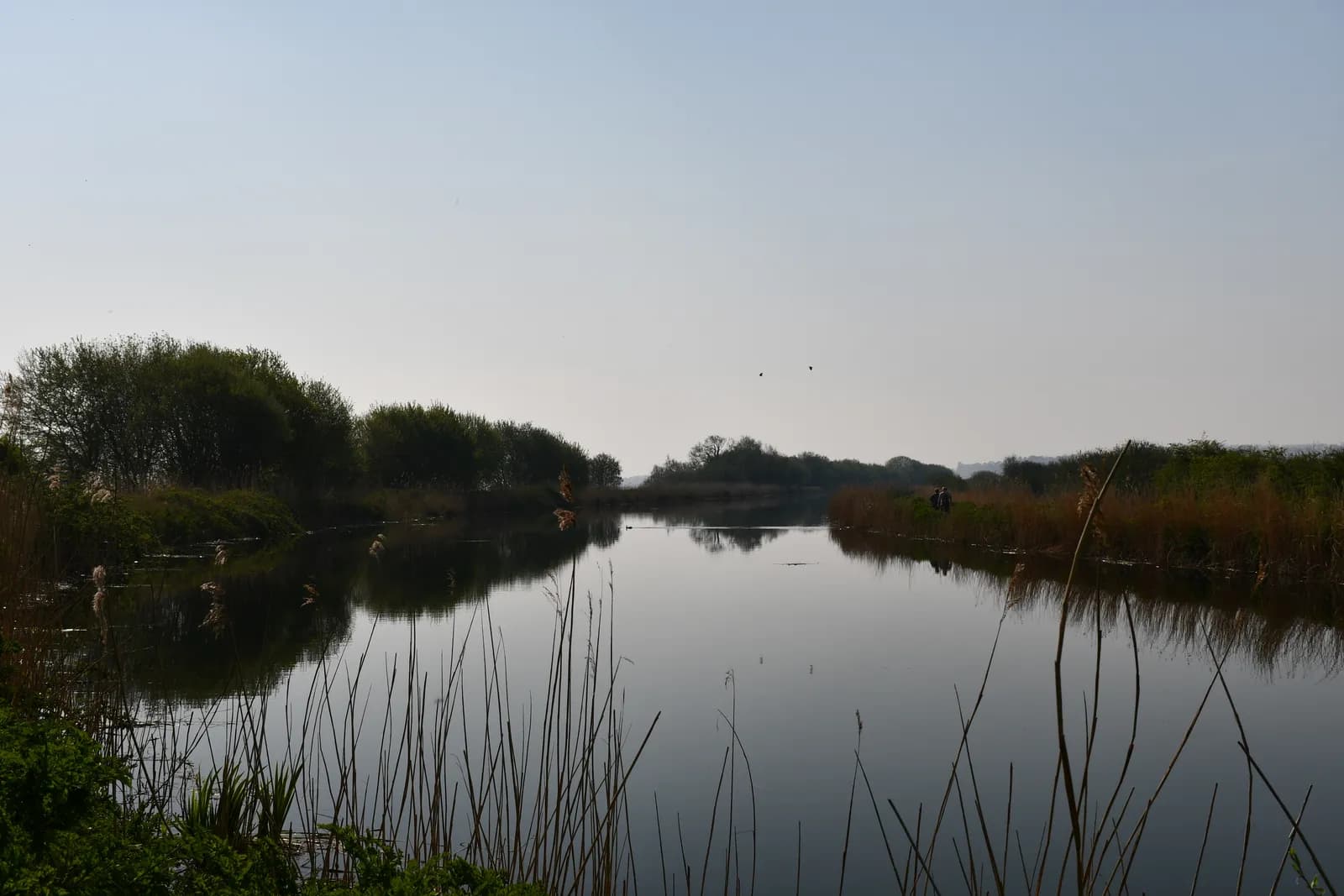
Exeter Ship Canal has carried cargo to the city for more than four centuries, surviving weirs, rival ports, and the arrival of the railway. Today the quayside is a leisure destination, yet its warehouses, locks, and basins still trace the outline of one of Britain's oldest artificial waterways.
The Weirs That Forced a Canal
Before the canal existed, seagoing vessels could reach Exeter along the River Exe. That changed in the late thirteenth century when Isabella de Fortibus, Countess of Devon, built a weir across the river in the 1270s or 1280s. In 1317 Hugh de Courtenay, 9th Earl of Devon, added another weir and a quay at Topsham, forcing merchant boats to unload downstream and pay tolls for overland carriage into the city.
Britain's First Pound Locks
By the mid-sixteenth century Exeter's merchants had had enough. In 1563 the city employed John Trew of Glamorgan to cut a new channel around the blocked river. The work was finished in late 1566 or early 1567. The original canal was three feet deep and sixteen feet wide, running 3.25 miles from below Countess Wear to Exeter. It included the first pound locks in Britain, allowing boats of up to sixteen tonnes to reach the quay. Trew's Weir, which maintains the water level in the quay, still bears his name.
Expansion and the Custom House
The canal was extended downstream towards Topsham in 1677, and a transshipment basin was added. After an enlargement approved in 1698, the original contractor William Bayley absconded, leaving the city council and volunteers to finish the work by 1701. The upgraded channel was then fifty feet wide and ten feet deep, capable of taking ships up to 150 tons, and the three original locks were replaced by a single large lock. Traffic rose steadily: 310 boats used the canal annually between 1715 and 1724, climbing to 479 in 1750/51, while receipts grew from around £747 per year in the 1750s to £3,221 by the 1810s.
During this period the Custom House was built in 1680/81 by Richard Allen. It is the earliest purpose-built custom house in England and is Grade I listed, along with the attached wharfinger's house, extended in 1711, and the nearest warehouse.
James Green and the Turf Extension
In the 1820s engineer James Green extended the canal to Turf, two miles closer to the sea, with a new access lock that opened in 1827. A new basin was built at Exeter, the old entrance was closed, and a side lock at Topsham was completed in 1832. Green also built the Turf Hotel in 1825 to serve the trade. Receipts reached £6,253 in 1830/31 and £8,550 by 1842. The open-sided Fish Market, with cast-iron columns, was added in 1838 and is now Grade II* listed.
Missed Connections with the Railway
The canal's fortunes turned with the steam age. The Bristol and Exeter Railway link to the canal basin was postponed in 1832 and again in 1844. The South Devon Railway eventually ran services to the canal from 1867, but by then the channel was too small for large ocean-going vessels. Traffic declined as rail freight captured the market.
The Last Commercial Cargo
Commercial use persisted well into the twentieth century. In 1939 the canal still carried about 63,000 tons of material annually. One of the last regular users was the tanker Esso Jersey, later renamed Kieler, which delivered petrol until July 1971. A timber cargo in December 1973 marked the end of general commercial traffic. The sludge carrier Countess Wear, originally named SW2, continued to transport sewage sludge from Exeter Sewage Works to sea from 1963 until December 1998, when dumping at sea ceased.
From Sludge to Leisure
As commercial traffic fell away in the 1960s, leisure use increased. In the 1970s the basin stood in for nineteenth-century quayside scenes in the BBC historical drama The Onedin Line. A £24 million redevelopment scheme by Exeter Quay Developments in 2002 reshaped the city basin. Georgian and Victorian buildings now house antique shops, cafes, restaurants, and studios, while canoeists, rowers, and kayakers share the water once used by coal barges. The manually operated Butts Ferry, crossing the Exe at the quayside since at least 1641, continues to carry pedestrians; the current boat dates from 2005. The Cricklepit suspension bridge opened in 1988.
Heritage Harbour Status
Exeter City Council still owns the canal, which currently runs at an annual deficit of around £110,000. Negotiations to transfer responsibility to the Canal and River Trust ended in 2016. In 2021 the canal and basin became the UK's fourth Heritage Harbour, an award from the Maritime Heritage Trust and National Historic Ships UK. The designation recognises the survival of the custom house, wharfinger's house, warehouses, and the 1838 fish market.
Bridges and the Future
The Countess Wear swing bridge, dating from 1936, and the lifting bascule bridge added in 1972, remain obstacles to larger craft. Increasing the air draft to thirteen feet would allow more coastal boats to use the harbour. The western towpath now forms part of the Exe Valley Way, and the former sludge lagoons at the southern end have become the Old Sludge Beds Nature Reserve. This reserve is managed by the Devon Wildlife Trust and lies within the Exe Estuary Site of Special Scientific Interest.